|
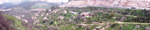 | | The remain of the village of Lifta | 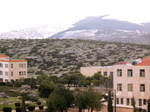 | | Photo by Rima Najjar Merriman taken from her room at the campus |
Where Are You From?
By Rima Merriman
I live in an apartment building adjoining the Arab American University - Jenin (AAUJ) on a hill surrounded by farmland and quiet villages. As I write, the wind outside my leaky windows has been howling for hours, adding to the desolation of the campus. The protracted semester, beset by student and faculty unrest, has finally ended. It is time to take stock and to plan ahead for the following semester.
When the weather is good, the view from the roof of my apartment building is breathtaking. There isn’t a single Israeli settlement in sight to mar the gently rolling hills and the Palestinian villages nestled among them. (As with any part of the West Bank, though, you don’t have to go far to come up against illegal Israeli settlements and the illegal Wall). Here and there, you can see the start of development -- the first ragged impression of a road slicing through a field, hills being divided into “lots,” a stone building coming up much too close to the dilapidated main road blocking the poverty behind it.
The scene is far different from the densely wooded college town in the Midwestern United States, where the ragged road of displacement took this particular Palestinian and where I raised my family. When my husband and I bought a piece of land there in the eighties, I stood on top of a tree stump at the highest point of the land and tried hard to see the horizon through the surrounding pines. “I must see the horizon,” I told my husband. Around me now, there is nothing but horizon.
For Palestinian expatriate nationals like me who have managed to find their way back to Palestine in order to contribute in some fashion, what’s on the horizon is far from clear. Our foothold is tenuous; we are here on sufferance by the Israelis who control the borders and the areas between towns and villages and who let us in carefully or not at all. Sometimes, even Palestinians fortunate enough (or unfortunate enough as the case may be) to possess Palestinian IDs wonder why we are here when we don’t have to be, suspecting ulterior motives of some sort.
Through Israeli noblesse oblige, we are here on B2 visitor visas stamped with “not permitted to work.” Locally, we are sometimes made to feel like visitors from outer space. Even among people where any conversation initiated by “Where are you from?” if conducted long enough, will uncover very few degrees of separation, bonds have slackened. Individual energies are, by necessity, focused on survival in the difficult present, and Palestinian collective “memory” is becoming increasingly fragmented.
The farther away geographically your origins are from a certain community or clan, the more frayed the bond. And there is nothing in the world farther away from the West Bank and Gaza than the Palestinian villages and towns taken over or destroyed by Israel since 1948. “Where are you from?” Students and faculty ask me continually. “Lifta,” I answer, only to be confronted by blank stares here in the northern West Bank. (Lifta, a Palestinian village only a few kilometres west of Jerusalem, is about to be turned into a luxury residential community for Jews, even as many of its original Palestinian inhabitants, especially the ones who now live in annexed East Jerusalem, are trying in vain to regain access to their homes and lands.)
“Where are you from?” asks the Israeli soldier at the checkpoint as he quizzically examines my American passport. I answer that, as he can clearly see from my passport, I am American. “No, but where are you from?” he asks again. “What do you mean?” I counter, to the discomfort of the driver of the van and my fellow passengers, who are holding their breaths now, wondering what illegality I am likely to fall under. “Do you mean where in America?” He gives up and satisfies himself by studying my tourist visa again. Should I have explained to this young person hailing from Russia or Ethiopia about Lifta?
In the small Midwestern U.S. college town in which I studied, worked, and lived for decades, there weren’t many other Palestinians. Although I have American and Jordanian citizenships and, more importantly, I have American children, I never could think of myself as anything but Palestinian. I know only too well what it means to be a Palestinian. I am still sorting out what it means to be Jordanian or American. “Where are you from?” other Americans ask me. The answer is much too complicated.
Teaching at AAUJ, I feel a pressing need, especially when I am discouraged, to ask myself what I am doing here. A recent World Bank report describes the quality of education in the Middle East and North Africa as not having kept up with economic challenges. It calls for reforms in order “to redirect educational approaches across all stages and all forms, to educate students on how to think and not what to think,” as a World Bank senior vice president puts it. In my experience, though, resistance to change, to new ideas, is everywhere I turn, especially if the impetus for change is being pushed by someone who must be asked, “Where are you from?” Nevertheless, the need in Palestine for qualified and dedicated individuals trained outside the Middle East is high.
There is an audio joke circulating on the Internet, a tongue-in-cheek telephone call between a Palestinian father somewhere in the West Bank speaking in the fellahi dialect and his son, who is apparently settled in England, married to “Barbara,” and announcing the birth of a grandchild, whom he has called “Mike” rather than “Shafiq,” after the grandfather. The conversation is entirely one-sided. Shafiq gives his son news about various mishaps that have befallen the family from divorce of a sister and abandonment of children to maiming by Israeli gunfire, to illness, to severe economic need, all the time assuring his son that the family in Palestine is perfectly fine and that he need not worry about them. The conversation ends with the father thanking the son for having contributed $100 to an NGO.
For Palestinians in the diaspora, the joke is far too close to home to be funny. We can and must do better. To rephrase part of a speech by J. F. Kennedy, we need to stop asking what Palestine can do for us, and ask, instead, what we can do for Palestine.
Rima Najjar Merriman is a Palestinian expatriate national currently chairing the Modern Languages Department at AAUJ. | |