|
|
|
|
|
|
|
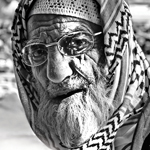 | | Photo by Zeid Issa. | 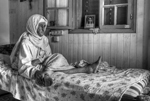 | | Photo by Ammar Younis. | 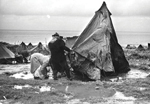 | | Palestine refugee men in Nahr el-Bared refugee camp, straighten out their tent again after winter storms blew it down and turned the earth into mud. Nahr el-Bared camp, Lebanon, 1951 UNRWA photo by My |
Oral History and Documentation
By Sharif Kanaana
This article has three parts: the first part gives a brief definition of what oral history is, the second cites examples on the use of oral history in documenting the Palestinian-Israeli conflict, and the last part proposes a simple plan for a project that can be appropriate for amateurs and trainees in the field of oral history.What is oral history?A distinction must be made at the outset between the subject matter of oral history and ‘oral history’ as an academic field of study. The subject matter is as old as history itself, and throughout the ages, people resorted to memory to preserve their past. The Arabs in particular relied on their memory to preserve the chronicles of their conquests and wars, and later to learn by rote the hadith (the sayings and teachings of Prophet Mohammad) and sirat rasul allah (prophetic biography). They had their own memorisers and narrators, and they developed methods for learning the Koran by heart and validating information. With the spread of reading and writing, reliance on memory diminished and people began to depend more and more on official written history. Oral history, as an academic field taught in many universities today, was introduced in 1978 with the publication of a book called Oral Tradition as History by the Danish historian Jan Vancina who worked in the Congo.Human means of expression and communication are divided into three types: written, verbal, and non-verbal. Official history is concerned with written history, while oral history is interested in verbal history. Non-verbal communication is a field of interest for both psychologists and sociologists. There are two main reasons for going back to oral history. The first has to do with the transformation of communication technology from the written to the visual and verbal. The other is the dominance of democratic culture that targets marginalised groups, i.e. people with special needs, the poor, women, labourers, etc. Both authorities and historians are increasingly taking marginalised groups seriously, and these groups tend to resort more to verbal expression than written expression.Oral history can therefore be defined as keeping the memory of the past alive in the present. This is the memory of those who experienced past events; it is a collective-social memory. Whereas written history deals with who, when, and where, oral history tries to find answers to why and how.A researcher on oral history has to go through four stages: data collection, analysis, presentation, and application. For the purpose of this article, we are concerned with data collection. Data is collected through verbal testimonials, which are of three types: individual or collective interviews; biographical interviews about the narrator’s personal life, general memories, or family and community; and linguistic or oral heritage. Linguistic or oral heritage constitutes a fertile source of material that can be used to document the social history of any community. It incorporates songs, tales, myths, superstition, anecdotes, jokes, pranks, proverbs, fables, popular epics, popular biographies, oral strophic poetry declaimed in a colloquial dialect known as zajal, names of places, names of persons, titles, proverbs, clamours, logos, slogans, graffiti, vendors’ calls, curses, invocations, blessings, and others. Even though oral history relies mainly on oral testimonials, not all people accept testimonials as absolute truth because there are some problems regarding the preparation and use of oral testimonials. These problems include (1) the manner of acquiring the testimonial, e.g. face-to-face interviews, phone interviews, questionnaire interviews, or email interviews; (2) linguistic nuances and semantics, since when people speak they use dialects, which differ from one geographical area to another;(3) how to convince narrators that they will not be exposed to criticism, harm, or financial or moral loss; (4) how to convince the local community that the information they convey will in no way harm the reputation or image of the community or air its dirty laundry; and (5) the space the historian has when preparing the testimonials for publication as history. Can the historian intervene, edit, explain, comment, omit, or add to the text? Other problems regarding the preparation and use of oral testimonials involve type and number of questions a researcher may ask the narrator, the subjectivity of the narrator, and the mental state and personal experience of the narrator. In order to overcome these problems, researchers collecting personal testimonials must be patient, modest, respectful of the opinion of other people, and respectful of the values of the narrators. Researchers must also have the interpersonal skills to be able to deal with all kinds of narrators.Once the problems are resolved, and if researchers have the characteristics required for professional collection of information, oral testimonials can be a better source of information than written sources for different reasons, including (1) testimonials are directly taken from persons who have been through the actual experience and therefore they do not leave room for doubt or falsification; (2) oral testimonials are an effective channel of communication for marginalised groups through which they can voice their concerns; (3) oral testimonials do not require that narrators to know how to read or write; (4) oral testimonials are inclusive and focus on all aspects of life; and (5) testimonials can be provided by men and women and do not restrict historical narratives to men only.The considerations above are useful for the researcher, but there are other considerations that are useful for interviewees, narrators, or information providers. Firstly, narrative and provision of information may empower marginalised groups and make them feel they are important and their opinion matters. Secondly, oral interviews raise people’s awareness of their problems and concerns, which is the first step toward resolving problems. Thirdly, oral histories create a link between generations and help the elderly become more involved in their society and environment. Fourthly, oral narratives strengthen communal spirit and collective work, and preserve the heritage and identity of communities. Fifthly, oral histories may be incorporated into the educational curriculum and form authentic learning material for students. Finally, oral histories rescue communities from imperial western prejudice.
Despite the fact that departments of oral history have been established in universities around the world, the field is still contested by many “official” historians. The oral testimony, on which oral history relies, is extremely important for Palestinians for many reasons, including the fact that most written documents from the British Mandate period were either destroyed, lost, or confiscated by the Israelis. The same happened to pre-1948 Palestinian cultural heritage, to all archives of political and cultural institutions, and to the contents of public and private libraries. Thus, the collective memory and identity of Palestinians relies heavily on oral testimonies.
Examples of the use of oral historyI have been working in the area of oral history for the past 40 years. I will first cite examples from my personal work on oral history, and then present my opinion of the best types of testimonials to document the Arab Spring. I used biography interviews in two projects, the first of which was a study of social change in the Palestinian society before and after 1948. The second was a documentation of the role of Palestinian refugee women during the 1948 War and its aftermath. I used individual interviews to document the quality of life in the 1940s in several Palestinian villages from where Palestinians were forcefully expelled. The villages were destroyed in 1948.I also used oral history to document the incidents and impacts of the two Intifadas, the Oslo Accords, the peace process, the Gulf War. I am currently using it to document the Fatah-Hamas political schism and the Palestinian society’s perspective of this schism and its political, social and economic ramifications. In these cases I used oral linguistic heritage, especially the political-social jokes, contemporary myths, stories about martyrs, rumours, and supernatural tales.Looking back through more than forty years of using oral history, I have found out that the ‘oral heritage’ makes up the best oral material compared to the oral or biographical interviews for the purpose of documenting the spontaneous and random socio-political movements including revolutions, insurrections, and intifadas, as well as the Arab Spring. Jokes, rumours, slogans, and clamours are ideal for the documentation of the Arab Spring.The oral interview usually revolves around what the researcher thinks is of utmost importance for the community. The researcher selects for the interview a few eminent people in the community, and their testimonials generally reflect the interest of the researcher and the viewpoints of very few people in the community. In contrast, popular arts reflect the interests of the community. They represent the community’s conscience, fears, desires, and concerns, and therefore provide a good source for study. Popular arts spread horizontally among people, and as a result they are easy to collect and document. At the same time popular arts form the core substance of the oral popular heritage that is transmitted from one generation to another. Moreover, since popular arts utilise the local dialect and popular culture, they can be studied only by locals who are familiar with that culture. On the other hand, amateurs and beginners encounter much difficulty in collecting and analysing oral heritage. Below I present a simplified project plan on the use of individual and collective oral interviews that can be of some benefit to amateurs, beginners, and trainees in the field of oral history. The project can be titled “A Project to Collect and Document Family Heritage,” which each beginner can use with his or her family.A project to collect and document family heritageThe following are main components of the project:1. Family Tree: Here one has to know how to analyse relationships, symbols, signs, and traditions. You will need to conduct interviews to collect information on the roots of the family. When all the required information is collected, you can draw a complete and organised family tree.2. Family Oral History: This involves the collection of information, stories, and myths about the origin of their family: where the family came from in the first place, why it left its original place, its places of residence, famous men or women in the family and their actions, religious men and men of science and politics in the family, special physical distinguishing features, and special accomplishments of family members, friends, enemies, and other information.3. Written Documents: Letters, birth certificates, death certificates, university and school certificates, diaries, manuscripts, IDs, travel tickets, permits, title deeds, land ownership, nationality cards, and licenses, in addition to relevant stories and myths.4. Family Treasures: Inherited precious items such as jewellery, weapons, furniture, clothes, pictures, books, keys, etc. 5. Family Features: Special physical features, deformities, psychological problems, behavioural patterns, types of clothes and food, special dialects, special use of words, manner of walking, special professions, etc.This plan can be expanded to become a genuine oral history of the family.Dr. Sharif Kanaan is the director of the Palestinian Heritage and Society Study Centre at Inash Al-Usra Society in Ramallah.See PDF www.thisweekinpalestine.com/i193/pdfs/article/oral_history.pdf
| |
|
|
|
|
|
|
|
|
|
|
|
|
|
|
|
|
|
|
|
See This Week in Palestine's Previous Edition
|
|
|
|
|
|
|
|
|
|
|
|