|
The Fabric of Our Lives
By Mira Rizeq
Everyone has the right to freedom of movement and residence within the borders of each state.
Everyone has the right to leave any country and return to his or her own country.
-Article 13 from the Universal Declaration of Human Rights
The Young Women’s Christian Association (YWCA) of Palestine has been working in the refugee camp of Aqbet Jaber near Jericho since 1949, and in Jalazoune near Ramallah since 1956. The YWCA has worked to support the livelihoods of women, children, and families in these camps by supporting a variety of projects including income generation, kindergartens, health education, psychological counselling, and so much more. It always responds to women’s needs in very effective and creative ways. As the organisation has moved more and more in the direction of a rights-based approach, it has become impossible to ignore the rights and aspirations of these refugee women.
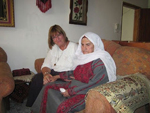
The YWCA thus started The Fabric of Our Lives in the summer of 2013 as an advocacy project that honours the stories of these women. Each of these women still vividly remembers 1948 and how they and their families fled the death and destruction around them. Overnight their families became homeless, landless refugees. After so many years, they still hope to return to their homes and lands, their orange orchards and vegetable gardens. They lost everything, but they never lost their memories and their dignity. All this has inspired us to continue to call for the Right of Return as a non-negotiable right, and an essential component of a just peace. By doing these interviews we have also come to a new understanding of women’s leadership, as they try to keep their families and communities together.
Will you hear my story? Will you support me? Oppression can never prohibit me from expressing my culture, heritage, history, faith, and dignity. My past was stolen, but will you help me restore my future?
These are the stories of Miriam, Fatima, Haiegar, Zuhdiyah, Zahiyya, and thousands of other women who fled from their homes and villages in 1948 and in 1967, and who still live in refugee camps in occupied Palestine, Jordan, Syria, Lebanon, and around the world.
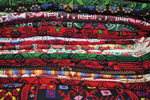
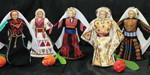
We honour these women by creating dolls named after them that wear the embroidered dresses of their region. The embroidered thobe was an important way for women to communicate who they were and which part of the country they came from. Through this project, we were able to interview women from Al-Masmiyya, Al-Kabira, Dayr Al-Dubban, Al-Dawayima, Dayr Yasin, and Beit Nabala.
The fabric of Palestinian life was ripped apart between 1947 and 1949. Over 750,000 people were forcibly removed and over 450 villages depopulated in a two-year period. Before the United Nations could set up its refugee camps, the YWCA was on the ground, offering shelter, food, and services. It was, and continues to be, committed to refugee rights today, including the right of refugees to return or receive reparations. The YWCA, along with many others, believes in and supports international laws especially UN Resolution 194 that clearly states that refugees have the right to return to their homes. It has been 66 years, and the refugees are still waiting!
Mariam who lives in Jalazoune Refugee Camp was 16 years old and newly married when she was forced to flee from her village, Beit Nabala, in July 1948. During the British Mandate, the soldiers set up a military camp just outside the village. When interviewed, she said, “I saw a woman breastfeeding a baby shot right in front of my eyes. I could not stop to pick up the baby, and I keep thinking, what has happened to that baby? When we fled, we left everything behind, even my wedding gifts”
So many women have a similar story, my mother being one of them. When she left Jaffa in early 1948, she was newly married, and I’ve heard her say so many times, “I just wished I did not leave all these closed boxes in gift wrap, all my wedding gifts so beautifully wrapped. I did not even open them all, but I never saw them again.” At the end of her interview, Mariam said, “Peace is our only source of hope.” Today, after all she went through, Mariam wants peace. My mother echoes her sentiment. She wants to see us all live in a better situation than what she lived through.
The patterns and colours of the dresses all have so much meaning in Palestinian heritage. Beit Nabala was a small village on a rocky hill overlooking Lydd. It was connected by a railway to Haifa. In 1945, there were around 2,500 people living there. This village no longer exists. The settlement of Kfar Truman was established west of the village site in 1949. Mariam’s dress is typical of the Jaffa region, embroidered with citrus fruits and cypress trees on white linen. All these stories and dresses reveal the broken hearts and the tragic events that began in 1948 and continue to the present.
Today and waiting
For another boat to break another siege
For mothers to make miracles raising their children
Only on water and lentils and no shoes for school
For some to let us be human and work
Others to just let us be Palestinians
And return….
Today and waiting.
-From the poet Rafeef Ziadeh
Fatima is a refugee from Aqbet Jaber Refugee Camp. She was six years old in 1948 when her family fled with the animals they had at the time. She was the youngest of six children. They fled to a nearby village eating only dates for few days, and then to Ajjour where they lived in a tent for four years. Her village, Dayr Addubban, was evacuated on October 23, 1948. In 1955, the settlement of Luzit was established by Moroccan settlers. Fatima also ended her story by saying “My peace is my future.”
Zuhdiyah lives in the old city of Jerusalem. She had to flee her village, Dayr Yasin on April 10, 1948 at 2:00 am. Her family lived on the west side of the village, and fled when they heard that the soldiers were coming from the east side, killing everyone including women and children. Dayr Yasin has become a symbol for the atrocities committed during 1948. In the summer of 1949, several hundred Jewish immigrants settled in this village, which today is known as Giv’at Sha’ul Settlement. Despite everything, Zuhdiyah said, “We want peace, so our children can have a better future.”
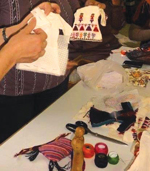
These stories triggered us to find more women and design dolls to represent the different villages they fled from. Each woman in Palestine has a story to tell, and by sponsoring a doll, we will work with our partners to bring about hope and justice, and call on the whole world to honour these women, and to call for freedom, peace, and dignity. This is the Fabric of Our Lives. It captures the stories, but, more importantly, the project delivers messages of peace: Without peace, these women can never restore their dignity. Without justice, these women and their families can never live in peace.
Today and waiting
The refugees are the last stumbling block so they negotiate us away
“They will never let us return,” child as if we need permission to be from There or had a choice to be from somewhere else.
From “Today and Waiting,” a poem by Rafeef Ziadah, a third generation refugee in Lebanon.
Mira Rizeq was born in Jerusalem and studied at Birzeit University, after which she pursued her graduate studies in business administration in the United States and then did her development studies at the Hague. Mira has worked with Save the Children, the UNDP/PAPP, and the Welfare Association Consortium. Since 2006, Mira has been the national general secretary for the YWCA of Palestine, and is equally passionate about advocating for women’s rights and music.See PDF www.thisweekinpalestine.com/i193/pdfs/article/the_fabric.pdf
| |