|
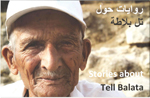 | | Rebhi H. Dweikat. | 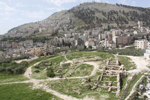 | | General view of Tell Balata. |
Memories of Tell Balata
By Hamdan Taha
Stories About Tell Balata is a cross-generational record of native stories by people living around the historical site of Tell Balata, an ancient Canaanite urban centre, identified as ancient Shikmu (Shechem). The site was inhabited 6,000 years ago and reached its zenith in the Middle Bronze Age, when its cyclopean wall, monumental gates, fortress temple, and domestic quarters were built. In the late Bronze Age, Labaya became king of Shikmu. He rebuilt the city, which flourished in this period, as evidenced in its material culture. A cuneiform clay tablet found at the site tells the story of a teacher who wrote to the parents of his students complaining about a delay in paying his fees.
The city was abandoned in the first century BC, and a new city, Nablus (Neapolis), was erected in the Roman period. It is the place where Jesus Christ met the Samaritan woman and asked her for a drink of water near Jacob’s well and the Nabi Yousef shrine. The village of Balata was built on the southern edge of the ancient tell in the Medieval period and continues to the present time, inheriting the legacy of the ancient tell. After the political upheaval of the Nakba in 1948, thousands of displaced Palestinian refugees from cities and villages inside the Green Line found shelter in the refugee camp adjacent to Balata village.
The tell was excavated by several archaeological expeditions throughout the last century. In 1903, the German scholar H. Thiersch connected the tell with ancient Shechem, and in 1908, a trove of metal artefacts were found by local residents while building a house. In 1913, Ernest Sellin began a two-season excavation at the site, and continued after the First World War with the Dutch archaeologist Fran Bohl, uncovering a substantial part of the city. In 1956 the Joint American Expedition began its work at the tell, and expanded the excavated area. Later, under the Palestinian Authority, the Palestinian Department of Antiquities began attending to its duties in preserving the site, and between 2010 and 2013, a joint Palestinian-Dutch expedition, in cooperation with UNESCO, managed to rehabilitate the site as an archaeological park.
Stories About Tell Balata records the people of Balata’s testimonies, personal feelings, and life experiences connected to this place. It is a spontaneous collection of stories from adults, young people, and even children, who are still forming their feelings towards the place. Tell Balata is a source of inspiration that activates their historical imagination, causing them to wonder about the previous people living in the place.
The history of the people of Balata is connected to this place. Some people were involved with archaeological expeditions. Their memories are still full of various stories about Tell Balata and the way in which its surroundings transformed over time. Some of them, such as the late Naser Dweikat (Abu Issa) and Jabr Salman, both field archaeologists, have become true icons of the site. But indeed there is almost nobody in Balata village who does not have a memory about the site about ancient people, prophets, treasure, expeditions, and even some who still can remember the names of archaeologists who worked at the site in the last century.
I was just fifteen when I first participated in the American excavation of Dr. Wright, says Seventy-eight-year-old Rebhi H. Dweikat. Once I found a piece of pottery with a figure of a woman feeding her child. It was so beautiful. Of course the director of the excavation took care of it, so I have no idea where it is now. But I loved the work at the excavation. It is such an amazing feeling to find an ancient object. It encourages you to dig harder and deeper, to find out what else is still covered in the soil.
Seventy-eight-year-old Rebhi Dweikat described her memories of her brother when he was foreman on the American expeditions. Mr. F. Asad, who is 81 years old, was a worker in the excavation. He described the daily life of the excavation: the camp, washing pottery, and other details. Sheikh Mazen described his experience as a teenager, saying that the excavations were like a three-month celebration for the 200 villagers working at the site. For children, the tell was the playground where they flew kites or played hide-and-seek. It is remarkable to observe the great interest that is demonstrated in these living testimonies. The people have strong expectations to see the tell developed as an archaeological park for visitors one day.
These stories were collected by a joint Palestinian-Dutch team that specialises in oral history, under the scientific supervision of myself and Dr. Gerrit van der Kooij. It presents a local perspective on the past and a dialogue between popular narratives of the site and discoveries made by archaeologists over the past century. It is a chronicle of historical research that started 100 years ago, which was once conducted by foreign expeditions, but is now carried out by local archaeologists and residents who are involved in writing their own history. They are now owners of this history, which is a source of self-esteem and an integral part of cultural identity, not just for the Balata village, but for the people of Nablus in general, including the refugee camps, which form a new neighbourhood for this historical place.
Dr. Hamdan Taha has been deputy minister of the Ministry of Tourism and Antiquities since 2013 and director general of the Palestinian Department of Antiquities and Cultural Heritage, 1995-2013. Since 1994, he has directed a series of excavations and restoration projects in Palestine. He is the co-author of the Qabatiya Publication (2005), Khirbet Bal’ama Water Tunnel System (2007), Jericho, A Living History (2010), and the author of many field reports and scholarly articles.
Article photos courtesy of the author.
From Stories About Tell Balata, Ministry of Tourism and Antiquities, Nablus, 2011. This oral history project was undertaken by a Palestinian-Dutch team under supervision of M. van der Dries and S. van der Linde, within the framework of Tell Balata Archaeological Park project, directed by H. Taha and G. van der Kooij.
| |