|
Why Don’t We Read? Why Don’t We Write?
By Diana Al-Salqan
Many parents notice the new guests sharing our couch, new technologies like the iPad and iPhone that are bringing all sorts of information to our children. Many blame such innovations for the lack of reading on the part of children. These tools, like the real world, offer the bad, the good, and the unwanted, but in a much more pervasive fashion. What is missing, though, is the knowledge necessary for our children and teenagers to filter out this tsunami of ideas.
Can parents’ “obsolete” knowledge suffice to inform their kids about the new world of free ideas? It is obvious that not only is control controversial and, it can be argued, no longer useful, it is also no longer an option. Since control and lack of controversy, the underlying two principles of our teaching and parenting ideologies, no longer serve the younger generation, where then can we look for a solution? Where else can we find a solution if not in reading?
It is not a question of using books as a tool; instead we should read in order to pursue knowledge. Reading a book could be done from the iPhone. It is not where one goes for information, but the critical approach that is necessary.
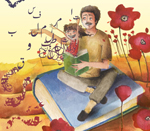
It all sounds too natural, a cliché even. Reading connects young generations to the world around them, and to their history. Reading can help young people escape to a different world; it expands their limited experiences as human beings, and can help them understand emotion and ponder life’s complexities. Reading is knowledge, and knowledge is used to solve societal problems. If societies need new experiences and new creative solutions to inherited problems, why then do societies continue habitual methods of teaching, especially when teaching reading? As an educator who taught reading for many years, I know that rekindling the passion is possible. Success was when some groups of students asked for the book to read at the end of the course.
However, misunderstanding or underestimating reading as “not fun” has reached an epidemic level in Palestinian society. Reading to primary school students is unimaginative, repetitive, boring, and pointless. The cheap uninspiring paper and images used in elementary school textbooks do not help to entice school children to read. The few-sentence stories are unimaginative and dogmatic. The characters are perfectly mannered school children. They behave as one is told to behave. The family is perfect: father reading the newspaper, mother writing on a paper, a student drinking his milk in the morning and sharpening his pencil, children crossing the street on the green traffic light, a flag fluttering on the pole. Watani is perfect. The lessons are followed by various exercises in a certain order that doesn’t change, even by the fourth grade. The exercises are mainly word-focused and grammar-based. Dictation and ta’abir, or pronunciation, are the last two exercises. Up until the fourth, fifth, and sixth grades, each lesson has to be copied and read aloud by all students. The students are rarely asked to talk or think about the world around them. Their realities are not to be found in books. The real world they live in is outside the window. Reading means reading this particular lesson, these few words, over and over again with the 30 or 40 students in the class from a rigid textbook. Reading in this sense is not reading. Real reading is a beacon of fun and knowledge.
Reading in primary schools can be a fun activity, and can be perceived as a positive experience. Children like to read about colourful, funny characters, superheroes, and magical strengths. For example, why aren’t the library classes, which only run for 45 minutes a week, used to tell our kids a story about a Palestinian boy who behaves like them, who feels bored like them, who dreams of being a football star or a superhero, and who can’t reach Jerusalem like them? And yes why not, with our primary school children, watch fun characters on TV with them and discuss why they like the character? Why do we keep TV cartoon characters as a shadow in their brains? Why not bring them into the classroom? Why not entice them to write a story that happened to them in school? Why not sit on the floor with them, or under a tree, or let them go and look for a story? I am sure their imagination is far more alluring than we believe it is. As these children grow up with a healthier attitude towards reading, they can resort to reading to quench their curiosity about their world later in life.
With the new technological advances of smart phones, iPads, and smart TVs, some fear the unwelcome ideas and information they bring to the living room. The real victim, however, remains the necessary knowledge that will help our children and teenagers to deal with the influx of controversial information in the real world. Reading and teaching reading can no longer be a luxury or an elitist endeavour. Transforming a nation’s future means catering to public schools, not only the elitist private ones.
My horror is doubled when the same ritual of reading ridicule is replicated in some higher education institutions. It consists of a chosen short article (the criteria of its choice is unclear to teachers) on an accepted uncontroversial topic, followed by analysis at a word or sentence or paragraph level, but rarely a higher level of analysis. The ideas in the article are briefly or superficially related to the students’ real life and then the teacher has to rush through a plan that is strictly connected to this particular textbook. Life is again kept cornered outside the pages of the assigned book and outside the walls of educational institutions. The lives that students live, issues students face, or questions they are dying to ask aren’t included. There is no time. You learn what you have to learn, which mainly consists of information irrelevant to and very far from students’ realities and lives. Testing is a repertoire of the so-called knowledge. So they memorise what they have to memorise.Our students, as they grow, never read about their realities and, therefore rarely contemplate their realities. A tormented existence of negligence and unaddressed dreams and problems is creating a cycle of escapism, alienation, and hopelessness. It is a schizophrenic existence that jumps between a perfect reality free of controversy, which is the unreal world inside the official books, and a highly controversial, puzzling real world that needs armies of writers and philosophers to understand it. Why, for example, aren’t our students in universities reading about a young Palestinian boy in an Israeli prison who is struggling with real-life questions and decisions? Why aren’t they reading about an unemployed man who can’t find a job or the money to travel, explore, or get married? How difficult can it be to stimulate the act of reading using such realistic issues and questions? Since 1967, haven’t we had more than one million young people who have experienced some sort of imprisonment? Why aren’t these stories being written? Our world and our lives are worth reading about and writing about. Controversy could be considered the secret of life, and the list of controversial topics keeps expanding in the twenty-first century. But in the official teaching institutions, the message remains that controversial issues like religion, politics, love, sex, marriage, governance, and even some scientific topics, are issues best kept inside our hearts. Depending whether he is at a public or private school, a child can sometimes be slapped on the face for looking outside the window in the ‘reading-out-loud class’ rather than listening to his 30, 40, or even 50 classmates recite words that sound so alien to his deafened brain. So too can the adult student can be slapped pretty hard if she starts asking questions or criticising her reality. How does deafening our children’s ears, marginalising their brains, or shunning their dreams and questions help? If we don’t read, we can’t sift through who we are, who we were, and ultimately, who we want to be inside human history or outside it. Is the erosion of our children’s identities and histories deliberate? Who in Palestine decides what we read and why? Reading should not be confined to certain words in an article or a set of doctrines defined by certain, sometimes unqualified, individuals. This definition of reading and knowledge as confined and controlled by a textbook or an article is being erased by those visitors on our couch, the new technologies. It is time to stand up to our responsibility as parents and as a society and offer respect to our future generations. We are not offering them the tools, knowledge, or the methods to help them survive their world. If we don’t read, we simply don’t write either. The society who writes its own stories, writes it history and future as well. Diana Al-Salqan, an author and educator, taught English language, reading, and writing for more than 10 years at Birzeit University. She holds an MA in European literature from Cambridge University, UK. She always used local content and youth-related modern issues in her English teaching materials and found amazingly positive results.
| |