|
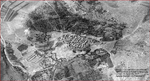 | | Annaba, Palestine 7 km south of Ramle. | 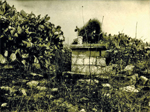 | | An old tomb in Annaba. | 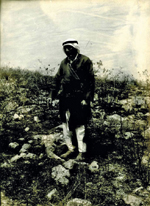 | | Annaba resident, Mr. Abdel Aziz Mahmoud Alian Wahdan refers to the site, believed to be the location of his father’s tomb. | 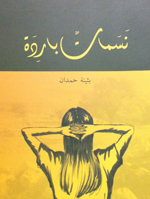 | |
Nasamat Bareda
By: Bothaina Hamdan
One day in 1948, in the early morning cold breeze with the first drops of dew lingering on the lemon and olive trees, men from Annaba Village were trying to secure it against attack. The women and children were spending the whole night in the vineyards, and in the early morning they returned home to prepare food.
The Haganah forces had attacked the town many times before the horrible night came. Under the bombs of helicopters, Annaba fell into Israeli control. The villagers and their families, including mine, hid in the nearest caves full of fear, not knowing what would happen next. As they fled the village, they passed countless dead bodies of women, children, and the elderly.
My Aunt Amneh’s story is an example of what happened in Annaba. She was twelve years old at the time. That day she returned home from the caves to get food to take back to the men. When her mother had asked her if she would be able to do that she innocently answered, “Yes, of course!” She returned to the empty village, “hearing nothing, neither cat nor monster.” She entered the house and once inside, she fed the chickens, watered the plants, and cooked okra for the first time in her life. She had no idea how to make it so she ground the okra and mixed it with tomatoes. She then carried the food on her head and moved quietly, hiding behind trees and rocks, out of the sight of the helicopters above. If they had spotted her, they would have killed her. She reached the cave where everyone else was hiding. They ate together the okra she made and were grateful to have something to eat. “ It was not the okra we were used to eating,” she noted. “It was a mash or soup.”
Annaba was a Palestinian Arab village in the Ramle Subdistrict of Mandatory Palestine. It was depopulated during the 1948 Arab-Israeli War on July 10, 1948 by the Yiftach and Eighth Brigades of Operation Dani. It was located 7 km east of Ramla.
In 1945, it had population of 1,420. The Romans referred to the village as “Betoannaba”. An elementary school for boys was founded in 1920 and in 1945, it had an enrollment of 168 students. Innaba also had a mosque, which was dedicated to al-Shaykh ‘Abd Allah and had a shrine for him.
When the Palestinians left their homes, they thought they would return. They simply locked the doors to their homes and never imagined what would happen next. People were not just afraid of the bombing, but stories of rape, collective massacres, and the smell of blood forced many families to run for their lives. It was an uneven war waged on innocent villagers. The story of Annaba gave me the chance to imagine my village. I imagined walking around in it, I imagined the houses, the villagers, the life they lived. I also learned the names of the main families. I learned how they had lived and died. I could almost see their faces and hear the children running around, going to school, returning from school, and playing outside. I cried a lot during the interviews and while transcribing and writing the stories. It changed the way I see Palestine. It brought me to love my country and respect its people even more.I cried again when I reached the part when my grandmother visited Annaba in the 1970s. With tears in her eyes, she climbed an old grapevine and allowed the memories to surface. My grandfather had refused to go. When someone told him that our land that had teemed with lemon and fig trees is now a land of avocados and nuts, he broke down in grief for his lost land. My grandfather, like many Palestinians, was transformed overnight from a landowner to a landless refugee. He moved to Al-Jalazon Refugee Camp and became a day labourer. And it was there he died. Our lives had been completely changed; each family member was forced to leave in order to find work, study, marry. The sense of a family centre was lost, and everyone is now scattered all over the world. Thus is the reality for most Palestinian families since the Nakba.Bothaina Hamdan earned a BA in radio and TV and an MA in international studies from Birzeit University. She is a writer and journalist who writes for local and international media. She has authored two books: Nasamat Bareda (Tamer Institute for Community Education, 2009) and Still Alive (Nasher News Agency, 2014).
| |